“Caesar once, seeing some wealthy strangers at Rome, carrying up and down with them in their arms and bosoms young puppy-dogs and monkeys… took occasion not unnaturally to ask whether the women in their country were not used to bear children; by that prince-like reprimand gravely reflecting upon persons who spend and lavish upon brute beasts that affection and kindness which nature has implanted in us to be bestowed on those of our own kind.”
Around the holidays in 2016, it became clear that my job wouldn’t last much longer. I’d spent the last two years working as a principal at a small diaspora lobbying group, coordinating closely with the Bush and Clinton campaigns in anticipation of a new administration. The election of Donald Trump turned all of that upside down. I wasn’t bitter about the outcome. On some level, it made sense to me but it blew up my professional plans. I would probably have to leave my job, maybe even Washington. I didn’t know what skills I had that were transferable, and though I knew I needed change, I couldn’t picture what that might look like.
So, in the absence of a plan, I started thinking about getting a dog.
My roommates expressed some hesitancy about our (my) ability to take on a dog. My friends' careers were slightly more secure than mine, but also close to politics and also disrupted by the unexpected election result. The reasons not to adopt were these: we lived in a chaotic group house, none of us was long on money or foresight, and we had no real idea what our lives would look like in six months, let alone six years. But in my discontent, I was unfettered.
And so I started researching the adoption process and even fostered a dog to get a feel for the experience. We spent a few days with a rambunctious pit bull named Joy who was almost certainly more than we could handle, and I think the episode confirmed my roommates' fears. In the end, Joy was adopted by another friend with more dog experience, and I looked for smaller animals that we could take on.
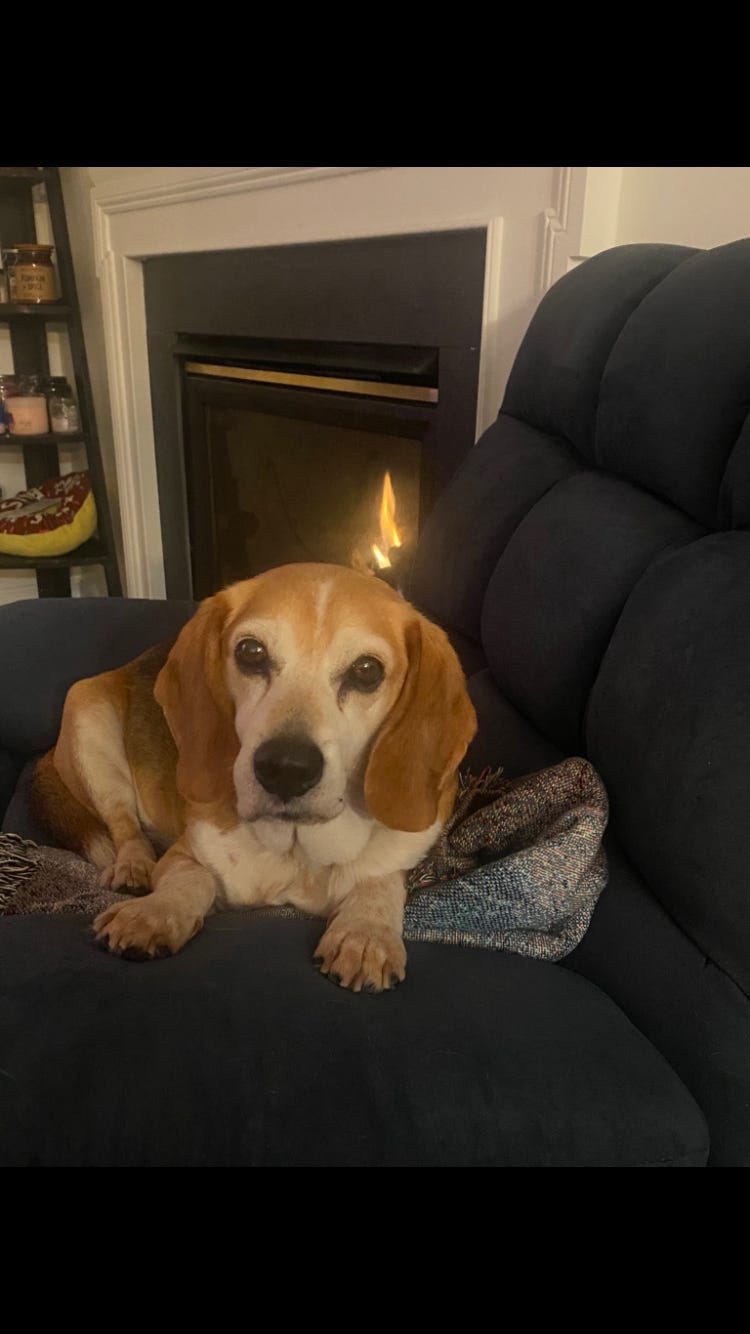
I remember scrolling through a rescue website, overwhelmed. There were dozens of profiles, and I didn’t even know what parameters I was supposed to be looking for. How small is small enough? How old is too old? Should the dog already be house-trained? Drowning in too much data and subsequent decision paralysis, I noticed that every dog on the site was described as having "high" energy except for one, listed as "medium." Arnold the beagle. It felt like a sign.
My roommate Eric and I picked up Arnold from where he was being fostered in Northern Virginia. According to the young woman taking care of him, Arnold was a howler. However, when we got the shy creature back to our house, he was quiet as a churchmouse. For those first few days, Arnold sat silently, shifting on his front paws, clearly nervous about yet another new environment. As I read through the papers from the adoption agency, I understood why. Arnold had been lost on the streets of South Carolina for an indeterminate period, moved between shelters and then between fosters before landing with us. He was between 4 and 6 years old according to the vet, around the age where people become hesitant to adopt. For us, Arnold’s age seemed to lower the stakes, and so it was just another aspect of his unique package that worked for us.
I can’t remember how long it took until Arnold was fully integrated into the flow of our lives and friendships, but I know it wasn’t long. He was affectionate in his own way, liking to press his butt against someone sitting on the couch, but not overly so, and even getting grumpy if you pet him too much. I appreciated that he never really licked or asked for pets, as some dogs do. He just liked to be nearby, to sit where he could see everyone. His one indulgence of affection was when it was particularly cold he would crawl in between human legs for warmth. He seemed instinctively good at doling out these special bonding moments evenly between the roommates, and if he had a favorite, well, it was probably just whoever walked him last.
This normal rhythm was wonderful in itself, but Arnold’s presence also began to expand our lives in unexpected ways. Our parents, scattered across New England, began referring to themselves as his “grandparents.” They competed to host him when we traveled. I remember one summer when Arnold’s “grandowners” took him ahead to a vacation house in Ohio. They almost seemed anxious to have time alone with the dog, as one might want to privately interrogate an exciting new girlfriend. By the time we arrived at the lake house two days later, they had already taken him to a carnival, had professional photos done together with our dog, gotten them framed and placed on the living room wall. Arnold remained the star of the trip, running around a large grass lawn with other neighborhood dogs, taking advantage of space and sun he didn’t have in Washington. For much of the days, in between swimming or drinking, we just watched the dogs play.
In retrospect, these moments weren’t trivial. They were acts of continuity. Handing off Arnold meant seeing each other’s families and dealing with each other's parents in ways we never had before. Visiting meant staying connected. Being close to the dog was always a good excuse to be closer to each other.
Arnold also pulled others into our orbit. One friend’s younger sister, long unsure about moving to D.C., finally made the leap after visiting and bonding with the dog. It might sound silly, but as soon as the two met, we all knew it was happening. My friend’s sister was perhaps a bit over-affectionate for Arnold’s tastes, but though he sometimes scampered away from the long petting sessions of her and her friends, the moment they left he would whine at the door. So why did she finally decide to move and join us? I think she may not have trusted us to stay solid and reliable, but she trusted Arnold. He had this effect on people. My aunt in Rockville, a soft touch for traumatized rescues, also adored him. She said her dogs had “forgotten how to be dogs,” and watching Arnold lie around in quiet contentment reminded them.
That’s what he did for us, too. He reminded us. We were young men trying to figure out what adulthood was supposed to be, uncertain how to behave, unsure of our responsibilities to each other, or what friendship meant in a city defined by ambition. Arnold was consistent context. You couldn’t ghost your friends or spiral into self-importance if the dog needed a walk or someone had to pick him up from Rockville. He reinserted us into the rhythms of care and attention.
If you’re online, as I am, you’ve probably seen the “fur baby” discourse: millennials treating dogs like children, strollers, birthday cakes, full-sized huskies in princess outfits at Disneyland. It’s easy to mock. The premise seems obvious: millennials, emotionally and economically delayed, channel the instinct to nurture into safer, simpler surrogates.
But the “fur baby” discourse misses something vital. It frames the trend solely as a substitution for children, but there are other important differences. Raising a child is a generative act, the commitment to building a future. A child comes with a built-in trajectory: they grow, they change, they become independent. A dog, in contrast, offers a kind of fixed point. No one expects a beagle to "become their own person." The relationship, while real and meaningful, is not reciprocal in the same way. It is rooted in presence, not in narrative. A child demands that we build a world around their future; a dog anchors us to what we already have.
We all live separately now, me and my childhood friends. The hometown house broke apart as love, career, and, yes, family replaced the old arrangement. But last week we were together again, to see Arnold on his way to the other place. For the first time in a while, four men in a room, hands on shoulders, with lots of hugs and a few tears. Physical touch and silent communion for the first time in too long. Arnold, even in death, teaching and giving us the things we need but have forgotten.


So sorry for thy loss. Arnold sounded a wonderful dog and thou lostest an important part of thy life with him.
Very sorry for your loss. I appreciate your story. It’s good for others, like me, to reflect. Hope you’re around again in a while. Godspeed.